Lead flashing and leadwork in Leeds
Lead flashing is the joint between the roof and everything that interrupts it: the chimney, the wall of a back addition, the valley where two slopes meet. It is where roofs leak, and it leaks long before the tiles around it have anything wrong with them.
Almost every leak I get called to on an otherwise sound roof turns out to be at one of those joints. The tiles are fine, the slates are fine, and there is a length of lead that has split, lifted out of its mortar joint, or was never dressed in properly to begin with.
The other half of the calls are lead that somebody has already tried to fix. Mastic smeared along the top edge, flashing tape stuck over a split, or a strip of felt where the lead should be. All three buy a winter and then leak worse, because water gets behind them and has nowhere to go.
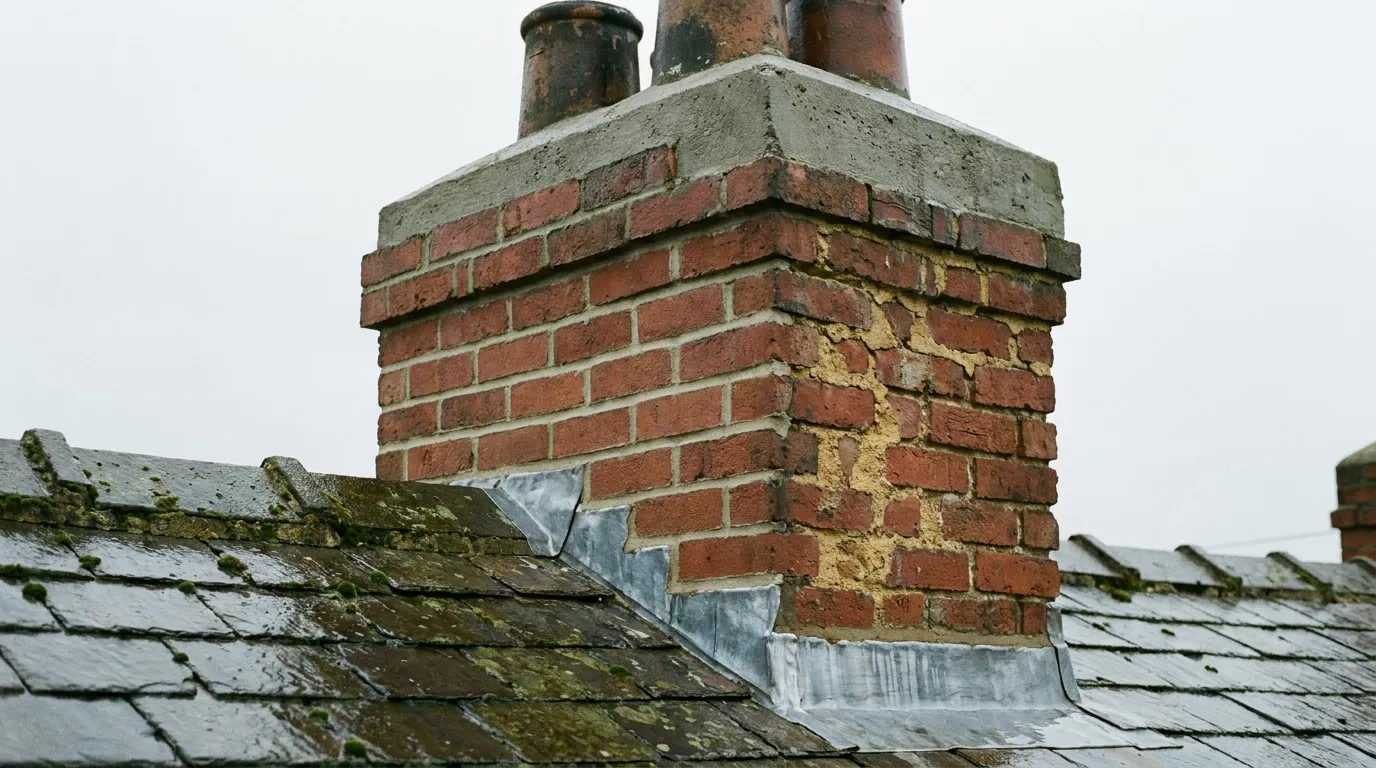
- Chimney flashing
- Lead valleys
- Abutment flashing
- Soakers and step flashing
- Lead repairs and replacement
You probably need this if
Signs worth acting on
- A damp patch on a chimney breast, upstairs or in the loft
- Water coming in where a back addition or extension roof meets the house wall
- Lead that has lifted out of the mortar joint and is standing proud of the wall
- A split or a crack along the length of a valley, usually at a fold
- Mastic, flashing tape or felt where lead should be
- Staining running down the inside of an outside wall after heavy rain
How I do it
What the job involves
- 1Find where it is actually getting in
Water runs before it drips, so the wet patch inside is rarely under the hole. The flashing gets checked along its whole length, not just at the obvious end.
- 2Rake out and re-dress, or replace
A sound piece of lead that has pulled out gets raked back into the joint, wedged and repointed. Lead that has split at a fold has usually fatigued and gets replaced rather than patched.
- 3Correct code lead, cut to correct lengths
Lead expands and contracts a lot, and a run made in one long piece will split itself within a couple of years. It gets cut to proper lengths with laps, which is the part cheap work skips.
- 4Dressed in, not stuck on
Lead is worked to the shape of the tile or slate underneath it so water runs over it. Nothing on the job relies on sealant to be watertight.
On your street
Why leadwork is most of the roof problem in Leeds
Leeds has more roof-to-wall junctions per house than most cities, and that is a housing stock fact rather than a figure of speech. The back-to-backs and through terraces in Hyde Park, Woodhouse, Harehills and Burley almost all have a back addition, which means a lower roof running into a taller wall, an abutment flashing the full length of it, and often a valley where the two roofs meet. Every one of those is a lead joint, and there are three or four of them on a house that only has one chimney.
On the Victorian villas in Chapel Allerton, Roundhay and Headingley the same junctions exist but bigger, with deeper valleys carrying more water off longer slopes. A lead valley on one of those is doing serious work every time it rains, and when it fails it does not drip into a loft, it runs down inside a wall and appears two rooms away.
The other pattern is age. A lot of Leeds leadwork is original, and lead that has been on a roof for a hundred years has thermally cycled through a hundred summers. It fatigues along the folds first, which is why the splits I find are almost always in a straight line along the bottom of a valley or the top of a step rather than anywhere random. Original lead that is still flat, still fat and still sitting in its joint is worth keeping. Original lead that has gone thin and crazed at the folds is at the end of its life and no amount of sealant changes that.
One thing worth knowing before anybody quotes you: lead is priced by weight and it is not cheap, so a quote that seems remarkably low for a valley replacement is usually a quote for something other than lead. Ask what code it is and how long the pieces are. A roofer who cannot answer that is not fitting lead.
Not sure if that is what you have got?
Send me a photo. I will tell you what I think it is and roughly what it costs, before anyone comes out.
Call 07770 902292Lead Flashing & Leadwork: common questions
Can lead flashing be repaired, or does it all need replacing?
It depends where it has failed. Lead that has pulled out of the mortar joint can usually be raked back in and repointed. Lead that has split along a fold has fatigued, and a patch there will split again within a year or two.
Is flashing tape or mastic a real fix?
No. Both buy you a winter at best. Water gets behind them and then has nowhere to drain, so the leak usually comes back worse and the damp has had longer to spread inside the wall.
How do I know the leak is the flashing and not the tiles?
Damp on a chimney breast, or on the inside of a wall where a lower roof meets it, is nearly always flashing. Water running through the middle of a ceiling away from any junction is more likely to be a tile or the felt.
How much does a roof repair cost in Leeds?
Most small repairs, a slipped tile or a bit of flashing, land between £150 and £400. A bigger job needs a look first. I quote in writing before anything starts, and the quote is the price.
Do you charge for quotes?
No. I come out, look at the roof properly, and tell you what it needs. If it does not need doing, I will say so.
How quickly can you come out?
For a leak, usually the same day or the next morning. I will get it watertight first and sort the proper repair once the weather allows.
Are you insured?
Yes, fully insured for public liability. Ask to see the certificate and I will send it over before I start.
Where I work
Lead Flashing & Leadwork across Leeds and about 15 miles around it.
Other things I do
Get in touch
Get a free quote from a local roofer.
Tell me what you need and I'll get back to you to arrange a look.